Key points


Introduction

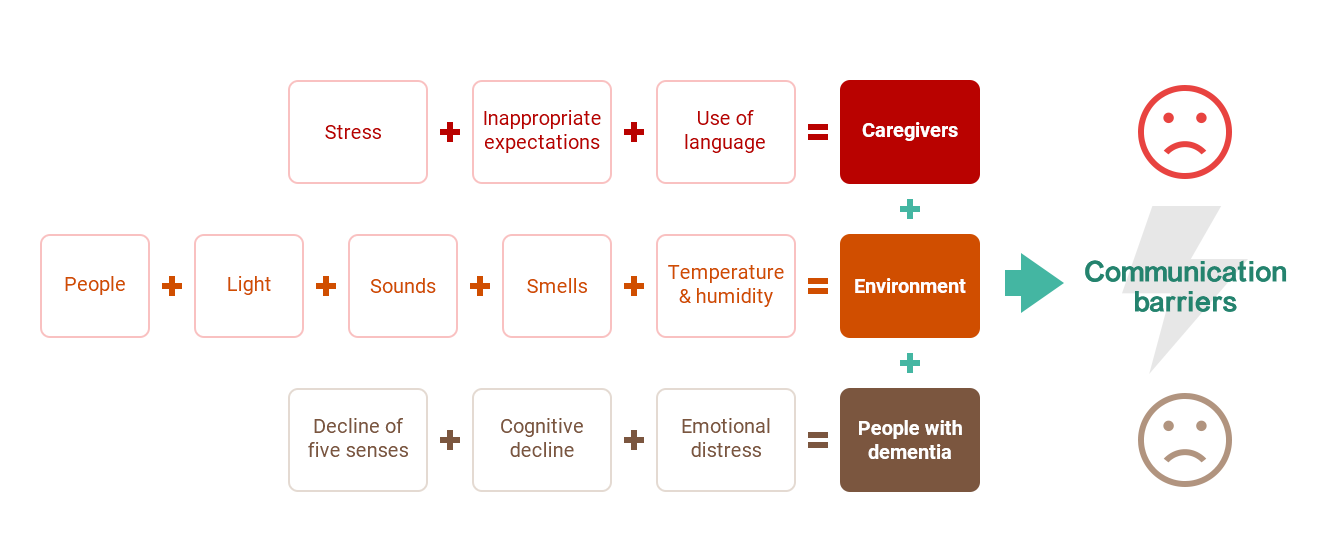
Barriers to effective communication

Barriers to effective communication
Communication barriers at the early stage
Causes Handling
Receiving
  • Decline of vision and hearing.
  • Decreased attention span.
  • Prepare glasses and hearing aids for the person.
  • Avoid frequent changes of topic in conversations.
  • Summarize and repeat content if needed.
  • Keep the environment comfortable and quiet.
Decoding
  • Cognitive decline, leading to declining ability to understand long sentences and abstract directions.
  • Decrease in concentration.
  • Speak with simple words in simple sentences.
  • Give the person more time to understand your message.
Responding
  • Declined language ability, leading to the use of ambiguous answers, such as frequent use of "Sure," "OK," and "Maybe."
  • Limited use of vocabulary, such as use of "there," "them," and "you know" to address specific places, people and things.
  • Encourage the person to express more, such as their feelings and emotions.
  • Be calm and open.
  • Avoid arguing with the person.
Communication barriers at the moderate stage
Causes Handling
Receiving
  • Slow response, such as requiring people to speak more slowly.
  • Further decrease of attention span, such as ignoring the external world once they think of a past event.
  • Stand in front of the person at his or her eye level before speaking.
  • Call the person's name and introduce yourself first at the beginning of the conversation.
  • Adjust your voice and speed when talking.
  • Observe the facial expression of the person and repeat your sentence in more simple words if he or she looks puzzled or has no response.
  • Keep the environment comfortable and quiet.
Decoding
  • Further decline of cognitive function, such as only being able to understand simple words and the mother tongue, and only paying attention to things in the visual field.
  • Further decrease in concentration, such as only being able to catch one or two words in a sentence, resulting in irrelevant answers.
  • Use actual objects, pictures, words, tones, facial expressions, and gestures to help the person understand.
  • Give the person more time to understand your message.
  • Avoid the use of pronouns, such as "he," "it," "that," and "something."
Responding
  • Further decline of language ability, such as being unable to speak in complete sentences.
  • Inability to find the right words to express thoughts and ideas, such as making frequent mistakes in saying the names of people and places.
  • Unable to use volume and tone to help express himself or herself.
  • Be calm and open.
  • Give more hints and praise the person more.
  • Avoid arguing with the person.
Communication barriers at the late stage
Causes Handling
Receiving
  • Limited ability to receive messages, such as being unable to recognize people are speaking to him or her.
  • Make sure the person notices you before you speak.
  • Call the person's name and introduce yourself first at the beginning of the conversation.
  • Adjust your voice and speed when talking.
  • Keep smiling and touch the person more, such as holding his or her hand or patting his or her upper arm.
  • Keep the environment comfortable and quiet.
Decoding
  • Limited cognitive functions, such as being unable to understand words and only able to understand gestures and touch.
  • Use actual objects, pictures, words, tones, facial expressions, and gestures to help the person understand.
  • Speak slowly and clearly.
Responding
  • Limited language ability, such as only being able to say "yes," "no," or incomprehensible sounds.
  • Only able to express himself or herself with gestures and sounds.
  • Trust that the person understands you, even if he or she shows no response, and continues to communicate.
  • Look for nonverbal cues from the person.
  • Try responding to incomprehensible messages from the person, such as patting his or her hand when he or she grips your hand.
Summary